Opening Pathways: Building Relationships for the Future of Conservation
Building Relationships • Sharing Knowledge • Stewarding Land
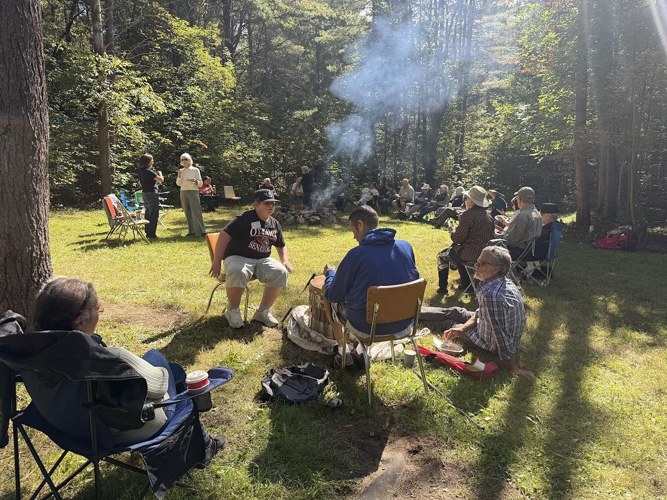
On September 25, Muskoka Conservancy welcomed First Nations representatives, conservation organizations, community partners, funders and regional stakeholders to MapleCross–Fraserburg Nature Reserve for Opening Pathways—an afternoon dedicated to building relationships, sharing knowledge and exploring opportunities for collaboration.
Held outdoors beside the reserve’s rustic cabin, the gathering brought together participants from Georgina Island, Rama, Wahta, Wasauksing, Pikwàkanagàn and Oneida, along with representatives from organizations working in conservation, Indigenous advocacy, land stewardship, employment and skills development, community heritage and environmental protection.
The afternoon began with an opening ceremony, song and remarks from Brian Sarazin of the Algonquins of Pikwàkanagàn First Nation. A land acknowledgement was offered by Muskoka Conservancy volunteer Joanne Smith and Greg Padulo of Generation Seven Consulting, followed by a welcome from Scott Young, Executive Director of Muskoka Conservancy.
Sharing knowledge around the fire
The fireside conversations explored shared opportunities for conservation, stewardship and community prosperity. Speakers brought a range of experiences and perspectives to the discussion:
- Kathleen Padulo of the Chiefs of Ontario spoke about First Nations as protectors of the land, the importance of thinking about future generations, and the opportunities that emerge when Indigenous knowledge systems and Western science are brought together with respect.
- Valerie Vanderwyk, Executive Director of Indigenous Skills, Employment, Apprenticeship, and Development (ISEAD), highlighted opportunities for employment, entrepreneurship, training and grant development in the conservation sector.
- Lillian Trapper of the Chiefs of Ontario and Nature Canada discussed Indigenous protected and conserved areas, the importance of Indigenous inclusion in conservation planning, and the need to create relationships grounded in understanding and respect.
- Ian Attridge, Indigenous Engagement Facilitator with the Alliance of Canadian Land Trusts, explored the potential for land trust properties to become places of healing, learning, restoration and reconciliation.
Together, the speakers emphasized the importance of protecting land and water, supporting healthy ecosystems, investing in young people and creating meaningful opportunities for Indigenous participation in conservation.
Looking at the opportunities ahead
The conversations at Opening Pathways reflected a shared interest in exploring practical ways to work together. Ideas included interpretive walks, Indigenous-language signage and place names, collaborative restoration projects, youth training, outdoor classrooms and increased Indigenous representation within conservation organizations.
Participants also discussed opportunities to connect partners around black ash stewardship, Indigenous youth engagement, joint funding applications, employment and skills development, and the exploration of Indigenous-led land trusts and other collaborative conservation models.
The MapleCross–Fraserburg Nature Reserve itself offered a meaningful setting for these conversations. Its wetlands, black ash swamp, mixed upland forest and diverse wildlife provided a reminder of the ecological and cultural importance of the lands we work together to protect.
Gratitude for many hands
Muskoka Conservancy extends its thanks to everyone who helped make the gathering possible, including organizing team members Greg, Joanne, Clarke, Jade, Reegan and Tamsen.
We are also grateful to Chef Ken Steele, a member of Oneida Nation of the Thames, for preparing a thoughtful and delicious meal featuring locally harvested venison stew and wild mushrooms. Thank you to Brian Sarazin and Keon for sharing their songs, and to Kathleen Padulo, Valerie Vanderwyk, Lillian Trapper and Ian Attridge for contributing their knowledge and perspectives.
Most of all, we thank everyone who attended and participated so openly in the conversation.
Continuing the journey together
Opening Pathways was a beginning—a chance to listen, learn and start building relationships around a shared commitment to land stewardship.
“This gathering sets into motion an ongoing conversation around land stewardship between Muskoka Conservancy, First Nations and a collaborative network of partners, funders and stakeholders in Muskoka and the broader region,” said Scott Young, Executive Director of Muskoka Conservancy.
We look forward to nurturing the relationships begun at Opening Pathways and working together toward a more inclusive, collaborative and connected future for conservation in Muskoka and beyond.
Chi-Megwiich.